CDR research gaps database
To offer an overview of existing carbon dioxide removal (CDR) research gaps, Carbon Gap has centralised and complemented existing resources and packaged them into a comprehensive, accessible database. The goal of this database is to support policymakers, researchers, funders and wider CDR ecosystem actors in making informed decisions regarding CDR funding. By identifying CDR areas that lack sufficient research or are underexplored, this initiative aims to help target funding where it is most needed to accelerate CDR research, development and innovation (RD&I).
This CDR research database is an ever-evolving tool. We need your expert feedback to ensure it is up to date with the newest sources of information, and that it remains relevant to the CDR ecosystem. Feel free to send feedback to eloisa@carbongap.org.
Database
How to read the information?
As mentioned above, the database consists of combined resources, harmonised to the extent possible. Some information may be missing when comparing different sources. As we are committed to respecting the authorship and the sources, not all information can be extrapolated.
There may be similar gaps for distinct applications of CDR methods under the same pathways. We have left these gaps in purposefully, to maintain a detailed overview of the efforts needed, and to account for the fact that progress is heterogenous among method applications.
For easier navigation, there are a few predetermined views for “Pathways” or “Categories” that you can chose depending on your area of focus. You can also use the “Filter” option to better select your preferred areas.
Pathways
The pathways included in the database represent either buckets of CDR methods, CO2 infrastructure or particular topics regarding governance towards which the funding should be directed. The following definitions proposed by RMI can serve as guidance:
- Geochemical CDR: "approaches that use naturally-occurring neutralisation reactions between acidic forms of carbon and alkaline minerals to convert CO₂ from the atmosphere into solid carbonate minerals or dissolved bicarbonates";
- Biogenic CDR: "approaches that use naturally-occurring biogenic carbon fixation mechanisms to capture CO₂ from the atmosphere. The most important of these mechanisms is photosynthesis";
- Synthetic CDR: "approaches that use engineered systems powered by low carbon energy to directly separate CO₂ from the air and capture it or to alter water chemistry to indirectly remove CO₂ from the air".
Note that the research gaps related to ocean carbon removal can fall across the three prior definitions depending on the application. We have labelled relevant gaps under the "Ocean CDR" category for simplicity. Variations and other combinations also apply, such is the case for methods falling under the "Syn(bio)" label. Please see the accompanying labels for further categorisation.
Resources
The CDR research gaps database centralises information from the following sources:
(1) Frontier's carbon removal knowledge gaps: an editable resource highlighting critical knowledge and innovation gaps in CDR technologies, categorised by attributes. It is designed to evolve with collaborative input.
(2) The Rocky Mountain Institute (RMI)'s Applied Innovation Roadmap for CDR: a comprehensive guide to advancing the technical readiness of 32 CDR approaches, offering guidance and examples on research, development and demonstration needs and opportunities.
(3) European Commission's report on R&I for climate neutrality by 2050: a report by the Directorate General for Research and Innovation (DG RTD) that looks at research and innovation (R&I) needs to reach climate neutrality by 2050 in the context of a forthcoming new Framework Programme for R&I. The results identify CDR as a key solution in need of R&I support and highlight the critical gaps that require attention.
(4) Carbon Gap's additions based on our own expertise, with a particular focus on justice and ethical governance.
Categorisation of current carbon removal research objectives
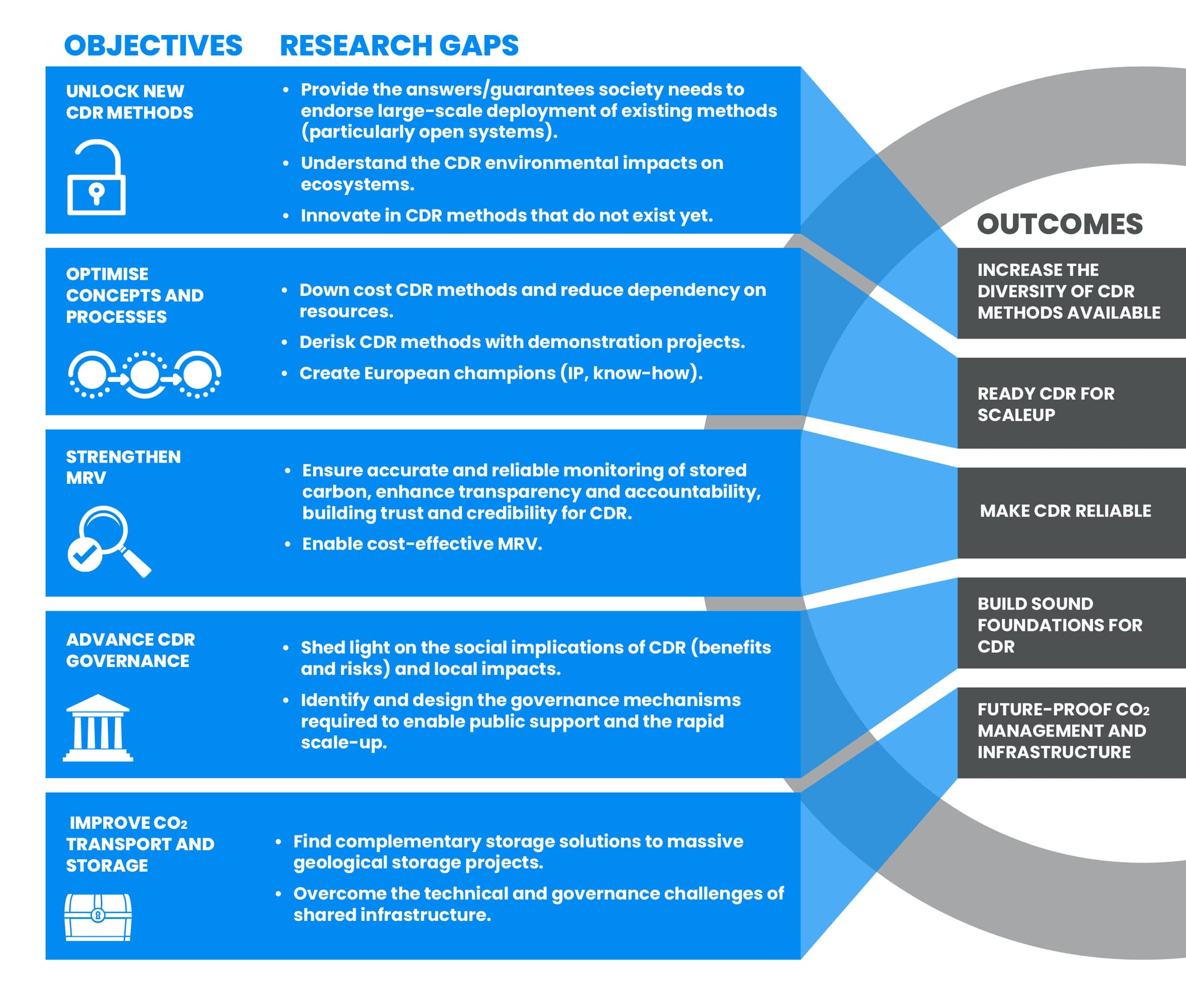
Five categories gather the main research objectives that still need to be addressed from the portfolio of removal methods.
Development stage, Technology Readiness Level (TRL) & types of work
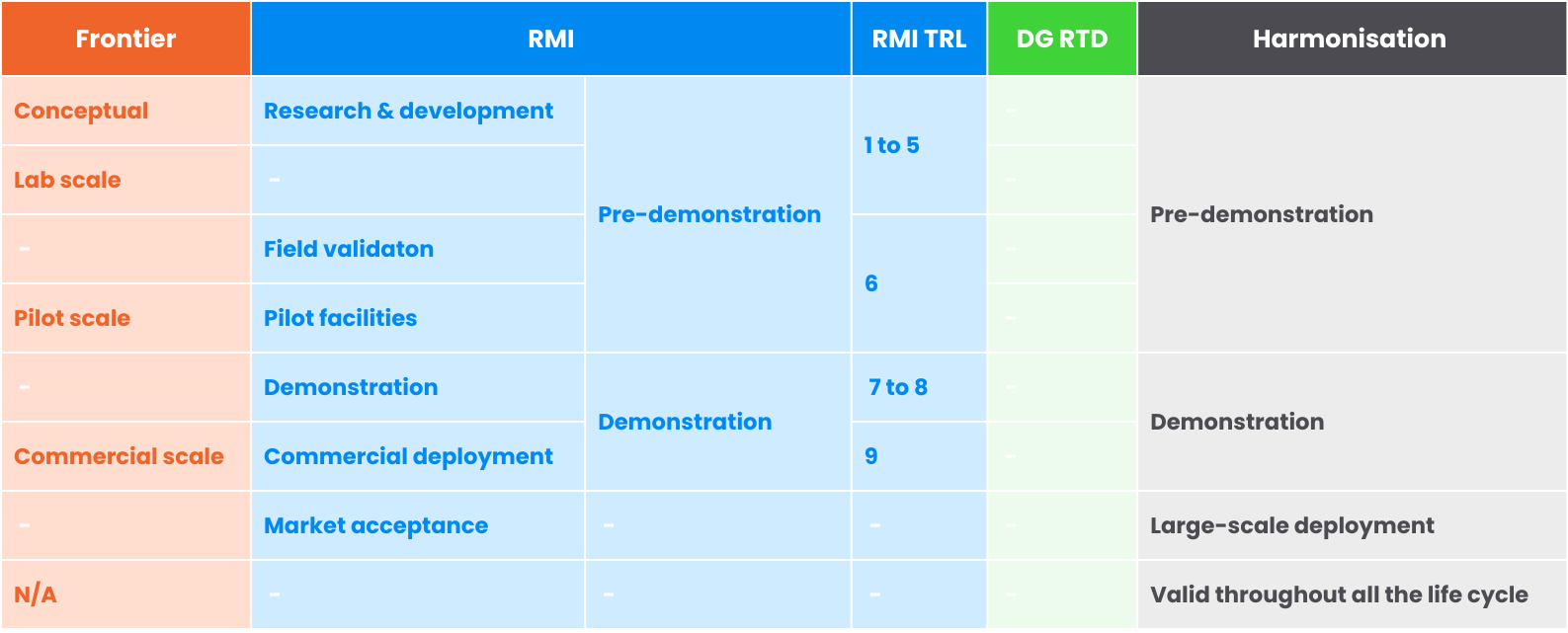
The three sources offer different information and situate the knowledge gaps within the development stages of the technologies in different ways. We have harmonised them when feasible to offer a compatible and comprehensive picture as seen in the table; empty spaces reflect the lack of explicit mention of a specific stage by the respected resource, as it is the case for DG RTD.