
Charting the path forward: Exploring compliance policy options for CDR in the EU
Explore EU policy options for scaling carbon removal through compliance mechanisms like ETS integration, removal trading schemes, and carbon takeback obligations, ensuring demand, integrity, and net-zero progress.
Download the full outcomes report pdf
Introduction
On 19 March 2025, Carbon Gap and the Negative Emissions Platform (NEP) jointly hosted a workshop to explore compliance policy options for permanent Carbon Dioxide Removal (CDR) in the European Union (EU). The workshop brought together 46 participants from across the CDR ecosystem, including 20 representatives from the CDR industry, 6 from think tanks, 5 from NGOs, 1 representative from the European Commission, and 8 invited speakers.
Through two subsequent sessions held under Chatham House rules, the workshop explored innovative options such as a Removal Trading Scheme (RTS) and an Extended Producer Responsibility (EPR) for oil and gas producers, also known as Carbon Takeback Obligation (CTBO), as well as the potential integration of CDR into existing policies, such as the EU Emissions Trading System (ETS), the EU Carbon Border Adjustment Mechanism (CBAM), the international aviation offsetting scheme CORSIA and the EU Sustainable Aviation Fuel (SAF) mandate. Discussions addressed key knowledge gaps and implementation challenges, as well as regulatory feasibility. Participants could also discuss and rate key principles for the development of CDR compliance policies in the months and years to come.
This high-level unattributed summary of the workshop discussions identifies the main questions raised, points of agreement and contention, and possible next steps.
In short, the main takeaways from the discussions were the following:
- Diverging views emerged on some of the contentious points linked to the design of compliance policies, including on which CDR methods should be prioritised. Still, there was a general convergence on the need to ensure strong MRV and liability requirements to guarantee their permanence.
- The innovative frameworks discussed – the RTS presented by Carbon Gap and the CTBO by the Carbon Balance Initiative – show significant potential in driving demand for CDR and helping reach Europe’s net-zero goals. At the same time, their complexity will require additional efforts both at technical and political level for their implementation.
- Existing EU schemes, such as the ETS, CBAM, CORSIA, and the SAF mandate, could allow for a swifter integration of CDR by amending current regulations. It was noted, however, that some of these schemes are only due for review in a few years. In most cases, an eventual integration of CDR will need to balance environmental integrity and competitiveness needs.
- A few common principles for CDR compliance policies were identified, namely: allow the EU to reach net negative emissions in the long term, prioritise permanent CDR, aligning with the “Like-for-Like” principle, support large-scale CDR demand across the economy, and ensure polluters pay for their historical or residual emissions. These provide a useful basis to identify which of the discussed CDR compliance options have more potential for development.
- In terms of next steps, participants from both the CDR sector and civil society were keen to continue engaging in constructive discussions to assess the best policy options to help scale up permanent CDR in a sustainable way and meet the EU’s climate and economic goals.
- Carbon Gap and NEP will build on the workshop input to support the ongoing work of EU policymakers in defining a package of policies to support permanent removals.
1. Key Goals for CDR Compliance Mechanisms
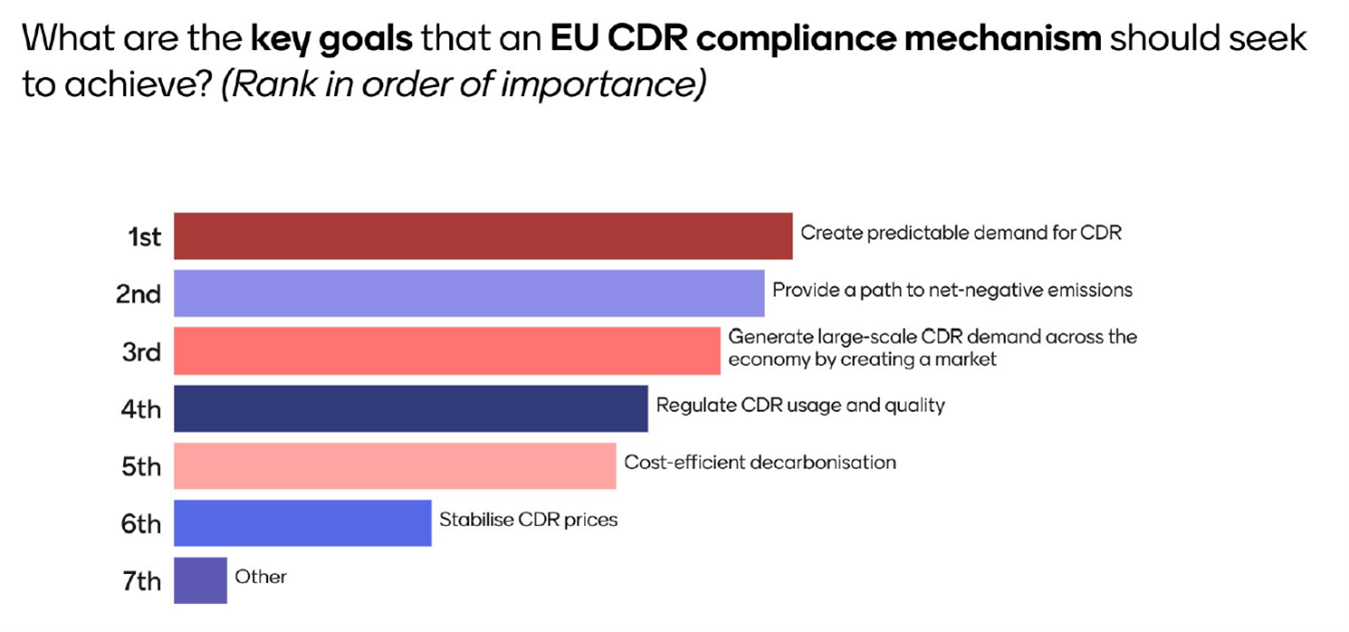
Asked to select from a list of options regarding the goals of a compliance scheme or propose their own, participants emphasised that a well-designed CDR compliance mechanism should, first and foremost:
- Ensure predictable demand for CDR and contribute to achieving net-negative emissions;
- Regulate CDR usage and quality while maintaining environmental integrity;
- Be cost-efficient and balance scalability with sustainable supply;
- Uphold the polluter-pays principle while considering companies’ ability to pay over time;
- Address residual emissions through a well-defined methodology and policy clarity.
2. Novel pathways
2.1 A Removal Trading Scheme (RTS)
- Introduces a growing obligation on private entities to perform CDR or purchase removal units;
- It could be linked to polluters’ emissions or economic production based on EU CDR targets;
- This innovative policy shows significant potential to drive demand for CDR. The political appetite for this option, however, remains uncertain.
The RTS was one of the most debated options, with participants interested in assessing its feasibility, design, and benefits. The presentation by Carbon Gap highlighted the main benefits of setting up an RTS, namely introducing a predictable obligation for regulated entities to purchase verified CDR units, creating a direct demand for removals that can grow over time to help achieve net negative emissions. It also illustrated two different design options: a first option based on addressing residual emissions of entities covered by the EU ETS I and II, and a second option based on a company contribution to EU CDR targets, to be allocated based on the company size and level of turnover, to align with its ability to pay for CDR. Some participants highlighted that the first option (linking RTS obligations to ETS-verified emissions) would be easier to implement and align with existing market mechanisms. There was also debate on whether the Like-for-Like principle of carbon flows should apply to the second option. Some participants hinted that, given in this case the obligation is not linked to a company’s emissions, a more flexible approach should be envisaged.
A key point raised by several participants touched upon ensuring a coherent approach in the classification of permanent CDR methods and related methodologies. In particular, the current difference in costs between permanent methods such as Direct Air Capture with Carbon Storage (DACCS) and biochar was indicated as a potential disruptive factor for prices and appeal of more durable methods in the context of an RTS or similar compliance option.
Given its innovative approach and complexity compared to the ETS, the political appetite for an RTS within EU policymakers remains uncertain. A key challenge in its implementation is linked to determining the appropriate percentage obligation for regulated entities under different RTS options. On the economic side, concerns were raised about the financial burden on companies and whether a phased implementation could address affordability over time, in particular for heavy industry and other entities already covered by the ETS I.
2.2 Carbon Take-Back Obligation (CTBO)
- Creates an Extended Producer Responsibility whereby O&G producers would be mandated to purchase CO2 storage units to compensate for their products.
- The EPR could be implemented as early as 2029.
- There are concerns about the risk of the costs being passed to the final consumers.
The Carbon Balance Initiative presented an Extended Producer Responsibility (EPR) for oil and gas producers, also known as a Carbon Take-Back Obligation (CTBO). Their presentation stressed the needs and benefits of introducing an EPR for CO2 as a way to ensure that producers of fossil products, as large emitters and highly profitable companies, contribute to addressing the environmental and social impacts of their products.
According to the speakers, the EPR should be implemented from 2029 onward, as the identified time of climate overshoot for Europe. Based on the EPR logic, fossil fuel producers should be required to continuously purchase Carbon Storage Units to demonstrate that their products have been effectively counterbalanced through permanent CDR.
Participants shared concerns about the risk of the higher costs being ultimately passed to the final consumers, a feature common to any compliance market, and the need to ensure complementarity between the EPR and the existing obligations stemming from ETS I and II in the EU.
3. Existing foundations
3.1 The EU Emissions Trading System (ETS) integration
- Safeguards to avoid mitigation deterrence are needed, including maintaining a cap on gross emissions and implementing supply controls, in particular for biomass use.
- ETS integration should be accompanied by complementary policies such as dedicated CDR targets, increased funding, and strengthened LULUCF regulation.
- An indirect integration by using ETS revenues to fund CDR is another potential pathway.
Participants discussed the nature of demand that would be generated through the integration of CDR into the EU ETS. It was noted that current market structures may prioritise the cheapest removal options first, potentially sidelining higher-cost technologies such as DACCS unless specific support measures are introduced.
To ensure a balanced and effective integration, several recommendations were put forward. These included maintaining a cap on gross emissions during the initial phase to prevent mitigation deterrence, implementing technology-specific supply controls – particularly in light of the sensitive debate around sustainable biomass use – and establishing clear rules around permanence.
The discussion also emphasised the need for complementary policies such as dedicated CDR targets, increased funding, and enhanced regulation of Land Use, Land-Use Change and Forestry (LULUCF). Some participants expressed concern that if CDR costs remain high, the sector could be marginalised within the Emissions Trading System (ETS). Questions were also raised about the kind of signal integration would send to polluters, with the potential for it to discourage conventional mitigation efforts. The idea of indirect integration, for example by using ETS revenues to fund CDR projects, was also discussed as a possible pathway.
3.2 The EU Carbon Border Adjustment Mechanism (CBAM)
- Including CDR in the CBAM compliance could create a broader international market for removals.
- A CDR/dollar approach could provide a solution to circumvent mitigation deterrence issues.
Participants explored the potential for integrating carbon removal into the EU’s Carbon Border Adjustment Mechanism (CBAM), a policy designed to prevent carbon leakage by levelling the playing field between EU industries subject to carbon pricing and foreign producers not facing equivalent constraints. While the current CBAM framework does not accommodate CDR, the idea of future inclusion prompted a range of perspectives.
It was noted that allowing CDR as part of CBAM compliance could create a broader international demand signal for removals, helping to stimulate global investment in high-integrity CDR projects. It could also serve as a tool to incentivise decarbonisation efforts in exporting countries, particularly in sectors where emissions are difficult to abate. Furthermore, participants highlighted that the inclusion of removals might support a more flexible and innovation-friendly approach to climate policy, aligning with longer-term goals of achieving net-zero supply chains.
However, some concerns were raised. One key issue was the risk of undermining the core purpose of CBAM – namely, to reduce embedded emissions in imports – by shifting the focus to compensation rather than direct mitigation. There were also questions about how to ensure environmental integrity, particularly in relation to the permanence and verifiability of removal credits used under the mechanism. An approach based on the importer’s economic value, such as CDR/dollar rather than being based on emissions using a CDR/tonne ratio, was suggested as a possible way to circumvent mitigation deterrence issues.
Overall, while the idea of CDR integration into CBAM was viewed as potentially promising in the longer term, participants generally agreed that further analysis, safeguards, and policy clarity would be needed before any concrete steps are taken.
3.3 CORSIA and the EU Sustainable Aviation Fuel (SAF) mandate
- The 2035 revision of CORSIA provides an opportunity to introduce a dedicated sub-mandate for CDR and address residual aviation emissions.
- The SAF mandate could introduce a fungibility between e-fuel requirements and removals.
The workshop also examined the potential role of CDR within the Carbon Offsetting and Reduction Scheme for International Aviation (CORSIA). As an international agreement aimed at offsetting aviation-related emissions, CORSIA currently allows the use of all types of carbon credits, provided they are certified by entities recognised by airlines. A key requirement is that corresponding adjustments must be applied to all carbon credits used under the scheme, ensuring that emission reductions are not double-counted by the host country in its own Nationally Determined Contribution (NDC).
Although the structure of CORSIA is fixed for now, it is scheduled for revision in 2035, which could provide an opportunity to introduce more specific provisions for CDR – such as the creation of a dedicated sub-mandate. This was highlighted as a potential pathway to strengthen the role of CDR in addressing aviation emissions in the longer term.
The discussion also covered the emerging role of Sustainable Aviation Fuel (SAF) mandates and their implications for carbon dioxide removal (CDR). While SAF is promoted as a lower-carbon alternative to conventional jet fuel, it was noted that it is not entirely emissions-free, and aircraft using SAF still rely on fossil fuel combustion to some extent.
Participants referenced ongoing policy developments, including aviation fuel mandates in British Columbia (Canada) and the United Kingdom. A key point raised was the potential interaction between the European Union’s SAF mandate and CDR policy, particularly in relation to the fungibility between e-fuels requirements and removals. Additionally, the carbon intensity of different fuel types was identified as an important factor that could influence both emissions accounting and policy alignment with long-term climate goals.
4. Broader principles on compliance policies for CDR
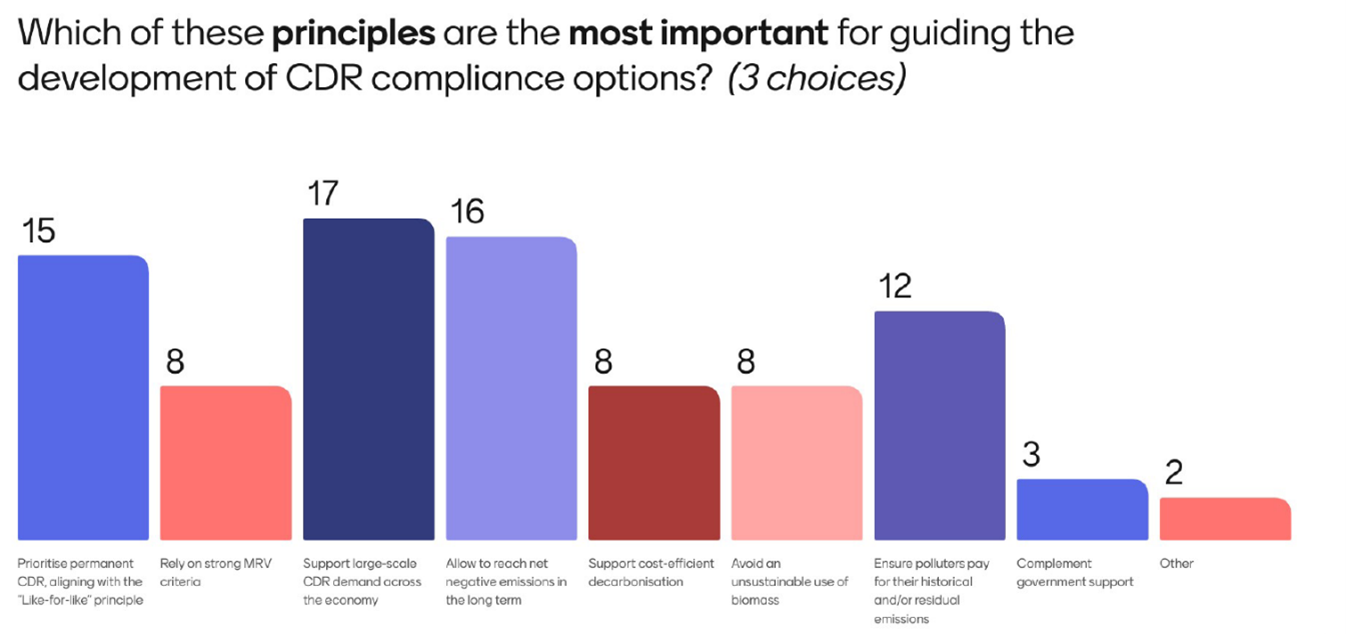
As part of the conclusions, participants were invited to agree on a proposed list of broader principles, linked to scale-up, cost-effectiveness and environmental considerations, for integrating CDR into compliance frameworks. Overall, the most voted options were the following:
- Support large-scale CDR demand across the economy;
- Allow to reach net negative emissions in the long term;
- Prioritise permanent CDR, aligning with the “Like-for-Like” principle;
- Ensure polluters pay for their historical or residual emissions.
There was a shared caution against positioning compliance markets as the primary driver for large-scale CDR deployment. Instead, it was emphasised that CDR should be incentivised carefully and used only to meet essential residual emissions, in line with planetary boundaries and in a way that avoids mitigation deterrence.
Some participants argued for prioritising land-based removals, citing their potential co-benefits, such as biodiversity enhancement and ecosystem restoration, others stressed the importance of scaling up technological removals as the only solutions which can store carbon over centuries and millennia, thus contributing to restoring safer atmospheric concentration.
The importance of fairness and proportionality in policy design was also highlighted. In particular, it was suggested that the implementation of the Like-for-Like principle should be calibrated based on companies’ pollution impact and financial capacity. Finally, some concerns were raised regarding the robustness of methodologies currently under development in the EU Carbon Removal Certification Framework (CRCF), especially concerning monitoring, reporting, and verification (MRV) standards.
Conclusions
The workshop provided valuable insights into the future of CDR compliance policies in the EU. While novel approaches offer appealing incentives to scale CDR, existing frameworks could allow for a faster integration of CDR, although they are only due for review in a few years. For instance, RTS and CTBO might offer effective avenues for CDR uptake, but their political feasibility remains uncertain. Across options, a key concern raised was the need to avoid placing a double burden on entities already regulated under the EU ETS. In this context, participants discussed the potential benefits of targeting oil and gas companies.
This discussion was particularly timely, as the European Commission is currently preparing an impact assessment for the next revision of the ETS, expected in Q3 2026. Several design options are being explored, and stakeholders were encouraged to engage in the forthcoming consultation process. The final draft is expected to be reviewed by the Regulatory Scrutiny Board by the end of the year.
As discussions on enabling policies for CDR progress, balancing regulatory effectiveness, market stability, and environmental integrity will be essential to ensuring that carbon removals contribute meaningfully to the EU’s net-zero and net-negative ambitions. Workshop participants representing leading actors from the CDR space and civil society committed to continuing to engage in constructive discussions to assess the best policy options to help scale up permanent CDR in a sustainable way and meet the EU’s climate and economic goals.
Over the next months, Carbon Gap and the Negative Emissions Platform will build on the workshop input to support the ongoing work of policymakers, namely within the EU Commission, in sketching a package of policies to support permanent removals.
_________________________________
About the organiser
Carbon Gap is Europe’s leading environmental advocate focused exclusively on Carbon Dioxide Removal (CDR). Our mission is to shape and enable policies that maximise Europe’s contribution to the rapid and responsible global scale-up of carbon dioxide removal.
The Negative Emissions Platform is an international industry association representing 50+ project developers, suppliers, investors, carbon marketplaces and buyers of permanent carbon removals.
Useful materials from academic and policy literature
Bellona (ed.) (2024): Joint Letter – Earmarking ETS revenues to deliver clean industrial competitiveness.
Burke J, Gambhir A (2022): Policy incentives for Greenhouse Gas Removal Techniques: the risks of premature inclusion in carbon markets and the need for a multi-pronged policy framework.
Burke J, Schenuit F (2024): Conditional fungibility: sequencing permanent removals into emissions trading systems. Environmental Research Letters.
Carbon Balance Initiative (2024): Carbon Storage as an issue of corporate responsibility. A Justice Perspective on the Carbon Takeback Obligation.
Carbon Balance Initiative (2025): Markets & Mandates – Policy Scenarios for UK CCS Deployment & Exploring the Role of a Carbon Takeback Obligation.
Carbon Gap (2024): Position—Integrating carbon removals into the EU ETS.
Carbon Market Watch (2024): Policy recommendations for EU instruments on permanent removals.
Clean Air Task Force & Concito (2024): The Balancing Act: Risks and Benefits of Integrating Permanent Carbon Removals into the EU ETS.
Danish Ministry of Climate (2025): Denmark’s position paper on integrating permanent carbon dioxide removals in the EU ETS.
European Scientific Advisory Board on Climate Change (2025): Scaling up carbon dioxide removals – Recommendations for navigating opportunities and risks in the EU.
Jenkins S et al. (2021): Upstream decarbonization through a carbon takeback obligation: An affordable backstop climate policy. Joule.
La Hoz Theuer, S, Doda, B, Kellner, K and Acworth, W (2021): Emission Trading Systems and Net-Zero: Trading Removals.
Negative Emissions Platform (2024): EU Compliance Market—NEP Position Paper.
Rickels W et al. (2022): Procure, Bank, Release: Carbon Removal Certificate Reserves to Manage Carbon Prices on the Path to Net-Zero. Energy Research and Social Science.
Rickels W et al. (2024): Build Carbon Removal Reserve to Secure Future of EU Emissions Trading. Kiel Policy Brief.
Sandbag (2024): In or Out: What’s best for carbon removals and the EU ETS.
Schenuit F, Aragones MP (2024): Broadening the carbon removal debate beyond the ETS. Euractiv.
Sultani D et al. (2024): Sequencing Carbon Dioxide Removal into the EU ETS. CESIFO Working Papers.