
A turning point for UK Carbon Removals: Reflections on the Independent GGR Review
The UK independent review on greenhouse gas removals was a milestone event for the country, positioning the UK as a global leader on GGR, by investing in GGR science, and innovation, related infrastructure, and market development, and in doing so, stimulate domestic economic growth.
In June, Carbon Gap launched our agenda-setting report on UK greenhouse gas removal (GGR) policy, Growth through removals: Making greenhouse gas removals a vibrant part of the UK economy. In it, we make the case for the UK to act as a global leader on GGR, by investing in GGR science and innovation, related infrastructure, and market development, and in doing so, stimulate domestic economic growth.
In March, the Secretary of State for Energy Security and Net-Zero commissioned an independent team, chaired by Dr Alan Whitehead, the former Shadow Minister for Climate Change and Net-Zero, to conduct a review of UK GGR policy. This week, the Review team published its concluding report. The Independent Review of Greenhouse Gas Removals is a sweeping evaluation of all aspects of GGR policy, with a focus on engineered GGRs.
Some of the recommendations of the Review directly address the asks we set out in our June report. The recommendations include those that are high-level (like supporting GGR innovation and centralising GGR within the UK carbon capture, usage and storage (CCUS) clusters programme) to the more granular (like excluding woodland units from the Emissions Trading Scheme (ETS) and expediting the development of GGR standards). At Carbon Gap, we welcome these outcomes and the positive direction the Review sets for GGRs in the UK.
We see this as a moment of real momentum – to leverage past policy successes and address emerging gaps, that can help secure the UK’s leadership position on GGRs internationally.
What remains is for the Government to take a position on whether to adopt recommendations in official policy, or to reject or delay action against them.
Below, we revisit the key pillars that shaped our June report, and outline what we see (and don’t see) in the Independent Review.
1. Drive corporate demand for GGR
What did we call for?
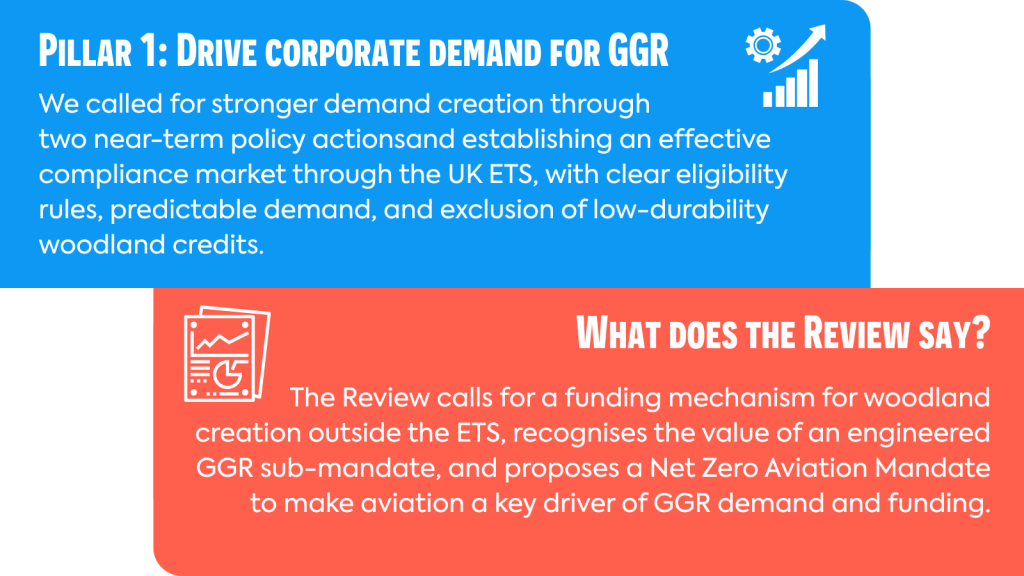
We see demand as the number one issue facing the GGR market – necessary to complete the business case for GGRs and unlock large-scale investment. In our report, we called for two near-term policy actions on demand creation. This included a public procurement scheme to address the near-term demand gap and build corporate confidence to engage in voluntary offtakes. Additionally, we called for an effective compliance market through the UK ETS. We argued that ETS integration in the UK should:
Establish a GGR sub-mandate or equivalent mechanism to ensure demand. Such a mechanism would clarify the role of GGR in the ETS and in the transition to net-zero, ensuring that an increasing share of ETS emissions are covered by GGRs. Critically, a sub-mandate (or equivalent mechanism) would also create predictable demand from the ETS, and in doing so help address the price differential between conventional allowances and GGRs – making GGR projects more bankable.
Set and communicate eligibility rules for GGR projects. The ETS should offer a mechanism for GGR project developers to be sure at Final Investment Decision that they will be able to sell their units into the ETS. This mechanism, again, is critical to the bankability of GGR projects.
Exclude low-durability woodland credits. We see an essential need for woodland creation in the UK but recognise limitations of integrating woodland into the UK ETS as a financing mechanism. Given the ETS is an essential market for engineered GGRs, integrating woodland could limit demand for engineered units and necessitate other financing options. Integrating woodland is also a divergence from the EU’s approach, and thus could be a barrier to the linkage of the two schemes. Excluding woodland from the ETS is also in line with independent advice from the Climate Change Committee.
What does the Review say?
Regarding the ETS, the Review recognises that existing plans to integrate GGR present a promising revenue stream for engineered GGR and can be done while ensuring climate integrity, for example by maintaining the emissions cap. It also identifies the challenges of price differentials (between ETS prices and GGR costs) and foregone ETS revenues, which could leave governments footing the full bill for integrated GGR units. This strengthens the case for our proposed sub-mandate, which could simultaneously buoy the price of GGR-backed allowances, and help navigate sector-specific obligations towards removals, particularly for aviation. Research by Carbon Gap, Green Finance Institute and Carbon Balance is cited, that the sub-mandate would impact compliance costs by 4-9% in 2050 to cover the full cost of GGRs – a small increase for covered entities while enabling a phase-out of public subsidy on each unit.
The Review echoes our call to exclude woodland from the ETS, agreeing in principle with the CCC advice on the “non-equivalence” of woodland removals and fossil emissions. The Review examines alternative options, and ultimately recommends the use of revenues from the ETS to fund woodland, rather than integrating them directly into the market. Crucially, the authors stress the ultimate importance that “a mechanism is put in place for funding woodland creation.”
In terms of other demand markets, one of the Review’s landmark recommendations is for the “Sustainable Aviation Fuel (SAF) Mandate to become a Net-Zero Aviation Mandate” in which GGRs and SAF are eligible instruments, and competition between them is encouraged. Given emerging evidence on the relative cost of SAF and GGRs, as well as growing recognition that the aviation sector should take on an active role in financing engineered removals, a Net-Zero Aviation Mandate could kick-start an effective financing mechanism for GGR by the aviation sector. The Climate Change Committee recently noted in its Seventh Carbon Budget that the aviation sector accounts for approximately 60% of engineered removals in the Balanced Pathway. Including GGR in the SAF mandate could be a critical unlock of much-needed demand for GGR, alongside the ETS. The change would theoretically also require no change to the fundamental policy.
The Review offers a thoughtful section on the thorny question of who pays for GGR long-term. The authors highlight the opportunity and the limitations of funding based on the polluter pays principle, recognising important considerations such as distributional impacts of cost pass-through. Sectors that could be implicated by different funding models are examined, with the conclusion that international aviation and shipping are those non-ETS sectors most suited to a polluter pays model, tying into the Aviation Mandate above – nonetheless, buildings, road transport, and agriculture are also flagged and further consideration may be needed.
Are there any gaps?
The Review stops short of recommending public procurement, as we called for in Recommendation 1a. Nonetheless, it recognises the significant valley of death challenges (see next section) facing GGR projects and the need for “additional support for pilot- and mid-scale projects” to secure a diverse pipeline of GGRs.
2. Lay the foundations for success
What did we call for?
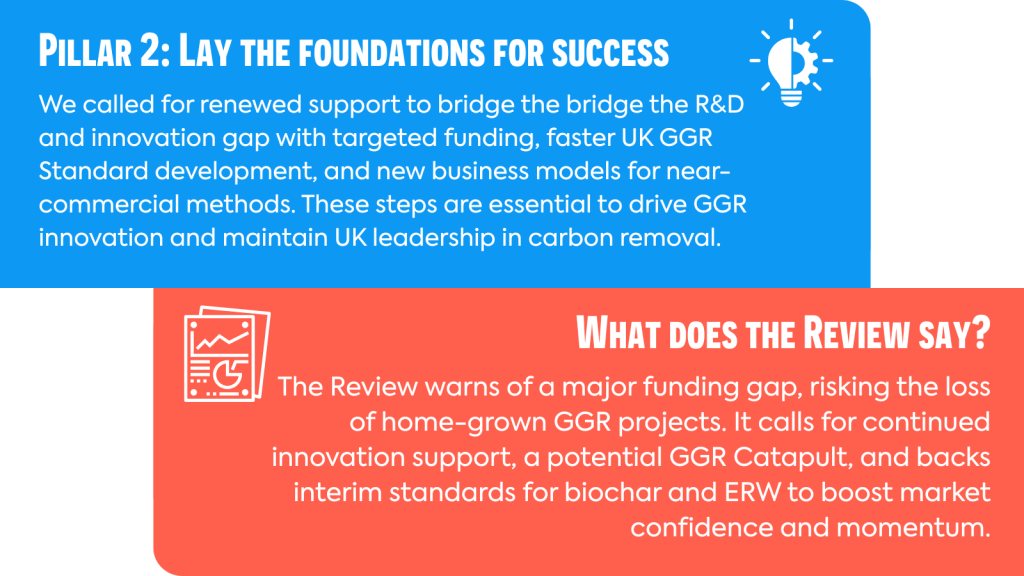
We see huge value in the UK’s early policy efforts to support GGR research and development (R&D) and innovation, with funding programmes that have been in place from as early as 2021. But this is now slowing with programmes ending and a potentially significant valley of death sitting between UK GGR innovators and their longer-term commercialisation. In June we called for:
Funding instruments for R&D, innovation and scale-up – namely through a GGR Innovation Catalyst Fund for thus-far underfunded methods, a dedicated loan scheme for projects transitioning from lab to first of a kind deployment, and potentially larger-scale debt or equity offered through the National Wealth Fund.
Maximising the impact of the UK GGR Standard by ensuring timely delivery of BECCS and DACCS methodologies, clarifying which further GGR methods could be included next, and outlining a process for regular methodology review.
Developing business models for other near-commercial GGRs, such as biochar and enhanced rock weathering (ERW).
What does the Review say?
A “significant gap” in innovation funding is left as the Net-Zero Innovation Portfolio programmes come to a close, presenting a threat to home-grown innovation projects, which could stall or look abroad for funding. The call for additional R&D support for GGR is also echoed by the IEA.
Alongside a call for continued support, as well as publishing the findings from programmes to date, the Review identifies a possible GGR Catapult to de-risk innovation, promote academic, policy and industry collaboration, and support GGR scale-up.
The Review recommends that the Government continue to develop the BECCS and DACCS standards, as well as new standards for biochar and ERW. Additionally, the Government should “endorse a suitable existing standard for biochar and ERW in the interim period (when available for ERW), while a government standard is developed.” With BSI commissioned by the Government to develop standards for DACCS and BECCS by 2027, but with no clarity on when standards for biochar, ERW, and other GGR methods might come, the recommendation to endorse an existing standard could enhance market confidence and allow projects to come forward.
Notably, in a separate announcement within the same week, the Department for Energy Security and Net-Zero (DESNZ) committed to align the methodologies under the UK GGR Standard to the EU Carbon Removal and Carbon Farming (CRCF) Regulation as much as possible going forward. This development helpfully reflects the Review’s recommendation for the UK to align to international standards and policies, with a view to supporting the voluntary carbon market’s development as well as to facilitate the planned linkage of EU and UK emissions trading schemes (given plans to integrate GGR into both schemes).
Are there any gaps?
Though some of our more specific recommendations – such as Innovate UK or National Wealth Fund financing, or an expedited timeline for standards – are not explicitly taken up, the Review injects much-needed momentum into the discussion on GGR innovation support in the UK.
3. Mainstream GGR in UK climate policy
What did we call for?
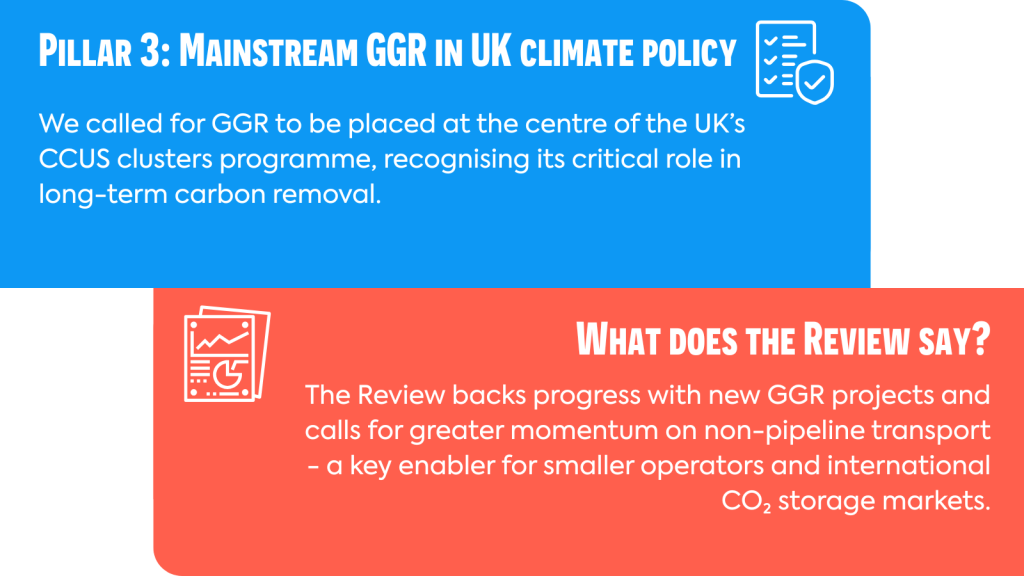
Despite early momentum in UK policy, today GGR remains a fringe issue with fragile political status and inadequate resources behind it. Though in the past year the Labour government has thrown support behind CCUS, GGR is scarcely acknowledged at the political level, despite its role as a key CCUS “capture sector”. (Indeed, the CCC’s Sixth Carbon Budget noted that GGR could be responsible for more than 50% of CO2 capture activity in the UK by the early 2040s.) We urged that GGR be placed at the heart of the CCUS clusters programme, recognising that taking CO2 out of the atmosphere and permanently storing it will be a major use of the UK’s CCUS sector in 2050 and even more so afterwards.
What does the Review say?
Since we published our report, DESNZ confirmed it would take forward two GGR projects to financial negotiation as part of its Track 1-expansion process, clarifying the pipeline for large-scale GGR project deployment in the UK CCUS clusters. Nonetheless, the Review provides recommendations to expedite and mainstream GGRs within CCUS cluster sequencing:
Non-pipeline transport. The Review provides a real boost to non-pipeline transport (NPT), which has been the subject of some policy development, but not at pace. It recommends that “accelerate planned policies to enable non-pipeline transport” ensuring clarity for prospective projects that might rely on non-pipeline approaches. NPT could be a huge unlock for the UK’s ability to supply CO2 storage to the international market. It’s also much-needed to allow smaller-scale GGR operators to set up shop in the UK. So, we welcome this development.
Access to storage. The Review highlights challenges for capture projects using NPT in accessing geological CO2 storage. The authors call on the Government to “launch a process for selling storage capacity internationally”.
Accelerate and expand cluster sequencing. Given that “delays in cluster development risk stalling investment” and put UK climate targets at risk, the Review recommends the Government to “accelerate decisions on the future CCUS clusters”, alongside “further expansion” of the cluster programme.
With respect to mainstreaming GGR, the Review calls for a dedicated GGR Strategy to be prepared by Government, as well as proposing an Office for Greenhouse Gas Removals as a means to promote cross-government coordination on GGR policymaking.
On mainstreaming GGR in UK climate policy, the Review goes beyond our asks from June. If the Government can address the policy gaps highlighted, we think the UK has a real chance to succeed as a leader on establishing a full GGR value chain and capturing the market opportunity for CO2 storage.
What else does the Review say?
Some other noteworthy findings from the Review include the following.
Geological net-zero recognition. The Review is one of the first policy-relevant reports we’re aware of that explicitly recognises the important principle of geological net- zero. This principle can be impactful in ensuring fossil emitters take responsibility for their residual emissions only through highly durable engineered removals, and limit opportunities for poor quality offsetting.
Overseas deployment. The Review offers a thoughtful and cautious approach to kickstart the discussion on whether GGR should be deployed fully domestically or in part internationally. The Review notes that “Part of the UK’s leadership on climate action should be built on demonstrating the feasibility of achieving net-zero in an acceptable and replicable way.” This means designing a GGR approach that is sensible in terms of its resource use and indirect impacts. The authors examine the challenges facing both domestic and international deployment, and highlight that DACCS deployment could have an international dimension given its durability and robust MRV. International collaboration could be explored through bilateral agreements, particularly where the UK is involved in co-investing and developing infrastructure. Meanwhile, “it would not be appropriate for the UK to source long-term carbon storage and non-permanent removals from overseas”. While this is not an easy conversation, it is well handled in the Review.
Biomass. The Government should minimise the use of imported biomass within its net-zero plans, given potential land use pressures, increased competition for feedstocks, and impacts on other countries’ deployment of GGR. This can be achieved through setting very high standards on feedstock sustainability, as well as by minimising the UK’s overall reliance on GGR.
Anaerobic digestion (AD). As a potentially untapped resource that could increase UK GGR capabilities, the Government should “give serious consideration to whether to increase ambition for AD”, but also “provide routes to market for new AD capacity.” The Review recognises the considerable, though also uncertain, potential of AD in the UK, estimating an additional 30 Mt/year could come from three routes – diversion of AD-derived biomethane towards BECCS, capture and storage of AD-derived CO2, and use of AD-derived digestate as a direct soil amendment or in pyrolysis to make biochar.
The Independent Review is an important milestone in shaping credible, scalable GGR policy in the UK. The Review team sought extensive expert input across academia, industry, and civil society, engaging over a hundred participants through eight roundtables, and receiving 143 submissions to its Call for Evidence. Carbon Gap has been closely engaged throughout, and we’ve been genuinely impressed by the rigour, transparency, and thoughtfulness of the process.
The thinking in the Review is thorough, and comes at a timely moment for the UK – one where past policy successes are beginning to become visible and remaining gaps are needing to be addressed. We hope the Government responds and takes on the proposals in a timely manner.