
Applying the Like-for-Like principle requires a growth of temporary removals
Our latest blog from Allix Baxter, Data Analyst, explores what is needed to apply the Like-for-Like principle, including temporary removals.
If we want to halt global warming, reaching net-zero is not enough. Instead, we need to maintain net-zero CO₂ in the long run by stabilising carbon pools and rebalancing carbon fluxes so the atmosphere stops accumulating heat-trapping gases. This is the logic behind what is called durable net-zero. When it comes to carbon dioxide removal (CDR), the Like-for-Like principle is the guiding star for effective and science-based mitigation.
In our recent brief, we explained the Like-for-Like principle and outlined two basic minimum integrity rules for applying it to neutralise emissions:
Residual fossil CO₂ emissions can only be neutralised with permanent CDR (for example, capturing and storing CO₂ underground).
Residual biogenic emissions should be balanced with biogenic removals, including temporary carbon storage in forests, soils, or wood products. Short-lived warming effects, such as methane, should be matched with removals that reflect the relevant duration.
These rules are not a mere technicality; they do three important things – (1) strengthen incentives to cut emissions, (2) clarify what temporary removals are for, and (3) create the demand signal permanent CDR needs to scale to the relevant volumes.
The sticking point: what is the role of temporary removals?
In the short term, temporary removals are also expected to deliver most of the CDR given they are much more mature and cheaper than most permanent removal methods.
Yet, once you accept Like-for-Like as the target goal, a practical question follows. If most emissions today are fossil, and fossil emissions must be met with permanent removals, does that make temporary removals a niche tool that fades over time?
This question matters because it sits behind a real concern in parts of the Nature-Based Solutions (NBS) community. If standards and policy get stricter about matching fossil emissions with permanent removals, will there be enough legitimate “neutralisation demand” for temporary removals? Put plainly, if like-for-like becomes the rule, will the pool of emissions that temporary removals can appropriately neutralise become too small?
To answer that, we need to be clear about what this pool of emissions consists of and what temporary removals are meant to do in a durable net-zero world. That is exactly where our upcoming publication on biogenic emissions comes in.
What we did: mapping the scale and sources of biogenic emissions
In our forthcoming analysis, we step back from market debates and start with a simpler question. What is the size and nature of human-driven biogenic emissions today, and how might it evolve?
Anthropogenic biogenic emissions are those released from the burning, decomposition, or microbial breakdown of organic material as a result of human activity. They are part of the short-term carbon cycle and still contribute substantially to warming.
We reviewed the sources, volumes, and gases involved at the global scale. We drew on greenhouse gas inventories, but we also looked at relevant sources that are not always fully captured in inventories. For example, the human-driven warming of natural ecosystems, like wetlands, can cause additional emissions from these environments. The aim was to build a robust picture of where biogenic emissions come from, what gases dominate, and what we should expect as we move toward net-zero.
The main finding: biogenic emissions are large and likely to persist
According to our review, farming, ecosystem change, and waste are the largest sources of biogenic emissions today. Globally, humans are responsible for over 17 GtCO2e of biogenic emissions per year (roughly 30% of our total emissions), a volume which is nine times greater than the current amount of temporary removals.
Although reducing emissions from these sources must remain a priority, many biogenic emissions are likely to persist or grow due to population growth, land pressures, and the destabilisation of ecosystems by climate change. Agriculture, is considered a particularly hard-to-abate sector. This sector includes biogenic emissions from livestock farming, manure use, crop residues, and the cultivation of particular crops like rice.
The figure below is from our upcoming report: it illustrates how the current GHG emissions could develop in the future and which sources could drive demand for temporary or permanent CDR strategies. Both permanent and temporary CDR methods will need to scale in the future to match the amount of future fossil and biogenic emissions respectively. It’s worth noting that some of these emissions (for example, nitrous oxide) don’t yet have a viable removal strategy.
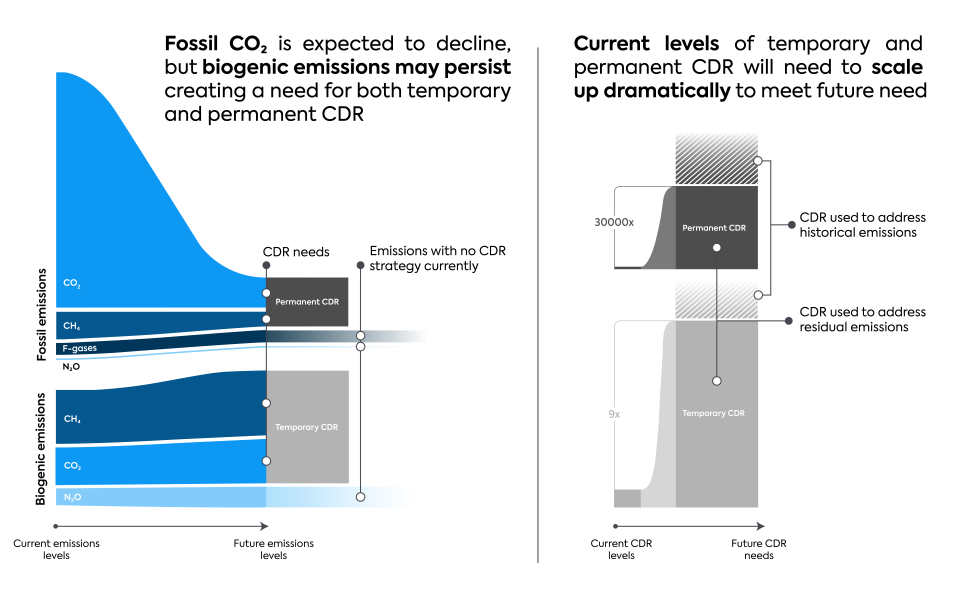
Clearly, there is, and will be significant biogenic emissions remaining requiring high-quality temporary removals to scale rapidly.
This finding changes the framing. Temporary removals are not a consolation prize for a fossil-heavy present. They are a structural component of how we balance the short-cycle carbon system in the future.
The real challenge is not “running out of emissions” to match, but rather matching emissions and removals correctly and building incentives that reward the right outcomes while protecting environmental integrity.
That’s why our upcoming report also includes a preliminary review of the EU policies relevant to biogenic emissions and temporary removals, highlighting limitations that currently weaken incentives and blur accountability. For example, the current policy focus on net targets can mask which sectors contribute the most to overall emissions, and whether changes in emissions or removals are more important for driving these results. The frameworks in place currently offer limited clarity on the role temporary removals should play in EU and international markets and how credit volumes and costs might be governed in the future.
Our findings make it clear that we should be moving away from a world where temporary removals are treated as a generic strategy for countering fossil emissions. Instead, they should be valued for what they can legitimately do. They can help balance residual biogenic emissions while supporting climate resilience and ecosystem health, and EU policy should reflect that. Stay tuned for further discussions on what that should look like.
Share