Spain is waking up to a reality that is reshaping climate policy across Europe: cutting emissions, even rapidly and deeply, will not be enough. To reach climate neutrality the country will need credible, durable carbon dioxide removal (CDR). And according to the Carbon Removal Readiness Assessment (CRRA) report released in Madrid last month, Spain has far more potential than most people imagine.
But potential is not the same as preparedness.
Closing this gap will require tackling three key challenges: defining a clear national strategy, scaling infrastructure and storage, and building a coordinated CDR ecosystem.
A country rich in possibilities… still without a plan
The CRRA, developed by Carbon Gap and Global Factor, paints a picture of a country rich in possibilities yet still missing the plan needed to harness them. Spain could remove up to 101 million tonnes of CO₂ every year by 2050 including its natural sink, more than three times what it would need to balance its residual emissions. This is not a marginal contribution to climate action; it is a strategic opportunity that could reshape Spain's role in Europe's path to net-zero.
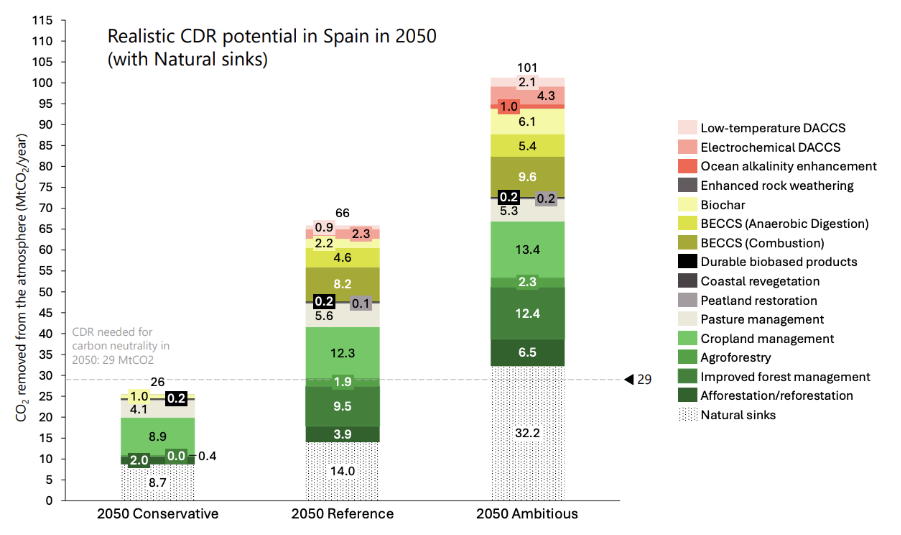 With the right policies, Spain could build one of the continent's most diverse CDR portfolios, reach net‑negative emissions before mid‑century, and even help other EU countries compensate for shrinking natural sinks. But today, the national climate strategy recognises only short‑lived, nature‑based removals. Durable approaches – from biochar and enhanced rock weathering to BECCS and DACCS – remain almost entirely absent from national planning. Public awareness is low, investment is limited, and the country still lacks a national CDR strategy to guide deployment.
With the right policies, Spain could build one of the continent's most diverse CDR portfolios, reach net‑negative emissions before mid‑century, and even help other EU countries compensate for shrinking natural sinks. But today, the national climate strategy recognises only short‑lived, nature‑based removals. Durable approaches – from biochar and enhanced rock weathering to BECCS and DACCS – remain almost entirely absent from national planning. Public awareness is low, investment is limited, and the country still lacks a national CDR strategy to guide deployment.
With the right policies, Spain could build one of the continent's most diverse CDR portfolios, reach net‑negative emissions before mid‑century, and even help other EU countries compensate for shrinking natural sinks. But today, the national climate strategy recognises only short‑lived, nature‑based removals. Durable approaches – from biochar and enhanced rock weathering to BECCS and DACCS – remain almost entirely absent from national planning. Public awareness is low, investment is limited, and the country still lacks a national CDR strategy to guide deployment.
The infrastructure gap: unlocking Spain's storage potential
One of Spain's greatest assets is barely visible in the public debate: its geological storage potential. In a Europe scrambling for secure CO₂ storage, Spain could become a regional anchor. Yet the infrastructure needed to transport and store CO₂ remains at the planning stage, and discussions about CDR are often overshadowed by a narrow focus on CCS for industrial emissions. The CRRA warns that without early investment, Spain risks losing a decade that will be decisive for Europe's climate trajectory.
The strategic gap: why Spain needs a national CDR plan
The Spain CDR Roadmap makes clear what must happen next. Spain needs a coherent national strategy that defines the role of CDR in meeting climate targets and integrates it into the National Energy and Climate Plan. It needs to accelerate the development of CO₂ transport and storage infrastructure, beginning with a national storage atlas and streamlined permitting. And it needs to build a balanced portfolio of CDR methods – not relying solely on nature‑based solutions but combining them with durable approaches that can withstand climate impacts and deliver long‑term climate benefits.
Policy signals will be essential. Without clear accounting rules, stable governance, and targeted public investment, early‑stage technologies will struggle to scale. The roadmap emphasises the importance of public procurement, innovation funding, and regional CDR hubs that can anchor industrial clusters. What Spain chooses to support – and what it chooses to price – will shape the trajectory of its CDR ecosystem.
The need for a coordinated CDR community
But infrastructure and policy are only part of the story. The CRRA's stakeholder interviews revealed something deeper: a country where CDR remains poorly understood, where actors work in silos, and where no shared national agenda exists. A post‑launch workshop in Madrid last month brought together DAC startups, nature‑based developers, researchers, foundations, and government advisors. Their reflections converged on the same point: the ecosystem is energetic but fragmented. Many participants had never been in the same room before. Some expressed concern about tensions between nature‑based and long‑term storage approaches, while others stressed that CDR should not be framed as a competition. As one participant put it, "the pie is big enough for everyone."
What emerged from the discussion was a strong appetite for more structured collaboration. Existing platforms – from CONAMA and MadBlue to regional carbon markets and the Spanish Biochar Initiative – could become natural gathering points. Madrid, several suggested, could serve as a national hub for coordination. But above all, participants agreed that Spain needs a unifying vision for CDR, one that recognises the complementary role of different approaches and builds trust with local communities, especially in regions where land‑based projects or storage sites may be developed.
Spain's decisive decade for carbon removal
Spain's recent Pacto de Estado ante la Emergencia Climática could have been the moment to anchor CDR in national policy, but the issue was largely left aside. Yet the window is still open. The science is unequivocal: stabilising global temperatures – especially as the world overshoots 1.5°C – will require both deep emissions cuts and durable carbon removal. The decisions Spain makes between now and 2035 will determine whether CDR becomes the missing piece of its climate plan or a central pillar of national climate leadership.
Spain has the geography, the scientific expertise, the industrial base, and the storage potential to lead Europe in carbon removal. What it needs now is a coordinated CDR ecosystem, the political will and a shared vision to turn possibilities into progress.