
The UK forges ahead on CO2 transport & storage infrastructure
The UK has driven forward promising policies on CDR to date, and these announcements set the tone for how momentum might be sustained over the next few years. Carbon Gap will soon publish recommendations for future CDR policymaking in the UK, and we will be closely analysing the implications of further for CDR over the coming weeks.
The UK has just announced some of the headlines from its Comprehensive Spending Review (‘SR’), setting out plans for government spending over the next three years. This is a critical moment for UK climate policymaking, setting out what level of investment we can expect over the coming years and the priorities for the new government over that timeframe.
“Energy security is national security” – Chancellor Rachel Reeves
While we’ll need to wait for more granular detail to accurately assess what the SR means for CDR, it sets a cautiously optimistic tone on UK climate & energy policy more generally, with Chancellor Rachel Reeves stating that “Energy security is national security” and announcing a series of spending commitments in particular around nuclear energy. We would also note that the Department for Energy Security and Net-Zero (DESNZ – responsible for ‘engineered’ CDR) appears to be amongst the better supported departments, although conversely, the Department for Environment, Food, and Rural Affairs (DEFRA) appears to be less well supported.
Most relevant so far to CDR was the hotly – and somewhat nervously – anticipated announcement that ‘Track-2′ of the UK’s CCUS clusters programme – adding the Acorn cluster in Scotland and the Viking cluster in the Humber to the ‘Track-1’ Hynet North West cluster and East Coast Cluster – is being supported by the government.
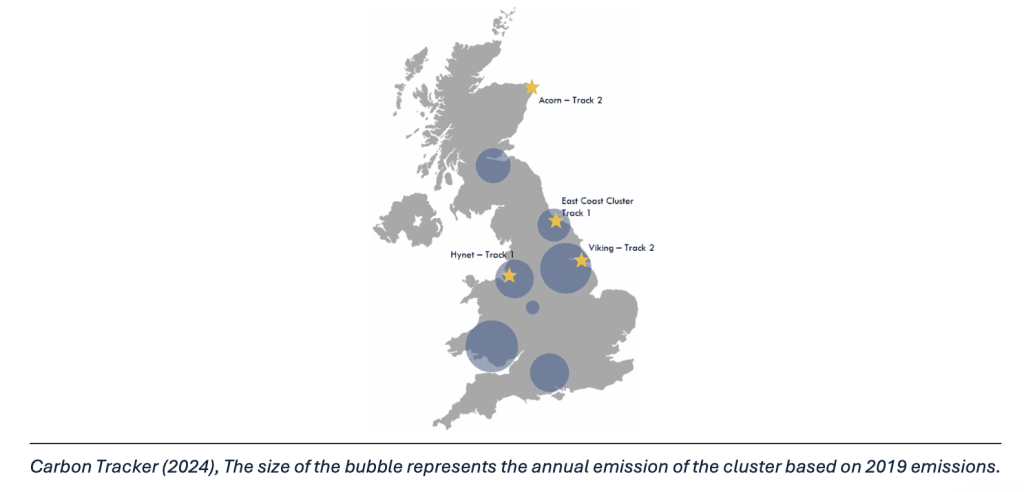
What does this mean for CDR?
Specific funding amounts are yet to be confirmed, but the CCUS clusters programme maintaining momentum is critical if the UK is to establish the CO2 transport & storage infrastructure that many CDR methodologies rely on.
“I’m cautiously encouraged by the attention paid to climate and energy in the Chancellor’s announcement, and in particular by the confirmation that Track-2 of the CCUS clusters programme will move ahead as planned. There are some more disappointing aspects, such as the declining support for DEFRA over the SR period (we’ll need to wait and see what that means for land-based CDR), but hopefully we’re in for more good news as more granular details emerge.” – James Townsend, Chief Growth Officer at Carbon Gap
We will be watching closely for more detail over the coming days – both on the topics above and on broader announcements such as those relating to research & innovation, with the Department for Science, Innovation, and Technology (DSIT)’s budget increasing strongly and with ARIA – the UK’s more experimental research agency-‘s budget also being increased, and industry and infrastructure, with Reeves promising “more to come in the weeks ahead, with our 10-year Infrastructure Strategy and our Modern Industrial Strategy”.
The UK has driven forward promising policies on CDR to date, and these announcements set the tone for how momentum might be sustained over the next few years. Carbon Gap will soon publish recommendations for future CDR policymaking in the UK, and we will be closely analysing the implications of further for CDR over the coming weeks.