Harnessing the Ocean: Marine CDR is an opportunity for EU climate action
Explore how marine carbon removal can support EU climate goals. Learn about mCDR technologies, Europe’s potential, and why investment, and research are key to scaling ocean-based solutions.
The EU has been steadily advancing its efforts to certify carbon removals from the nature-based and industrial methods. As it continues to develop its toolkit for neutralising ongoing or historical GHG emissions, the natural next step is to look towards to the ocean, where a suite of methods for removing carbon both through biological and geochemical systems could provide Europe a leg up in its efforts to counter climate change. With favourable geography, extensive expertise and existing infrastructure, Europe is well placed to develop these methods to become a leader in carbon removal.
What is mCDR and why is it relevant?
The ocean is an important climate regulator, and currently absorbs about 25% of anthropogenic CO₂ emissions each year through air-sea exchange at its surface and uptake by photosynthetic organisms. This natural capacity to buffer some of global warming’s impacts can be enhanced via human intervention by increasing the ocean’s ability to take in and store carbon in its waters and sediments, methods collectively known as marine carbon dioxide removal (mCDR).
Marine CDR has certain advantages over land-based methods due to the ocean’s enormous surface area and massive biogeochemical potential. MCDR is a good complement to land-based methods because it can help reduce land-use conflicts and lessen dependence on limited geological CO₂ storage. These advantages mean that large-scale marine CDR could be a game-changer for keeping 1.5 °C within reach — but only if we act now to crack the science, close the policy gaps, build robust monitoring, and supercharge innovation.
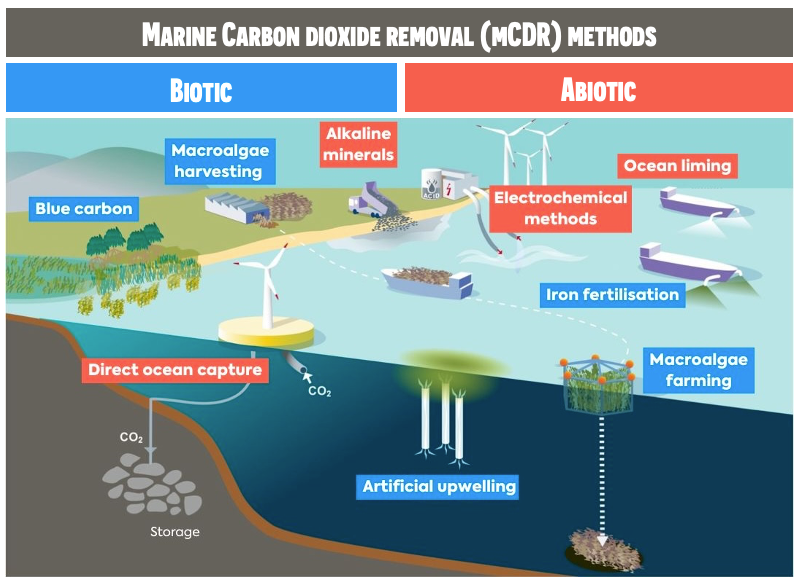
There are two main types of marine CDR methods: abiotic methods work through chemistry and physics—like adding alkaline minerals to seawater (termed ocean alkalinity enhancement: OEA) or using electrochemical processes to boost the ocean’s capacity to absorb CO₂. Biotic methods harness the potential of living organisms to store carbon in coastal regions (blue carbon) and offshore—for example by growing and sinking seaweed.
Modified from Oschlies et al. (2025)
But there remain a lot of unanswered questions. Although many mCDR techniques show promise, most are still very new. Scientists agree that we need more research into their storage potential, monitoring best-practices, and environmental and social risks. Some of these questions can be addressed by integrating mCDR into regional and global earth system models to understand how large-scale deployment could affect the planet’s biogeochemical cycles, but more importantly, we need to bring these technologies out of the lab and into open-ocean field trials where we can test them under diverse, real-world conditions. Only then can we answer the big questions—How do they perform across ecosystems? What are the short- and long-term impacts of altering ocean system at scale? How durable are the carbon benefits, or is there any risk of them being undone through processes like outgassing? In short, we must move quickly to validate—or rule out—the true potential of mCDR.
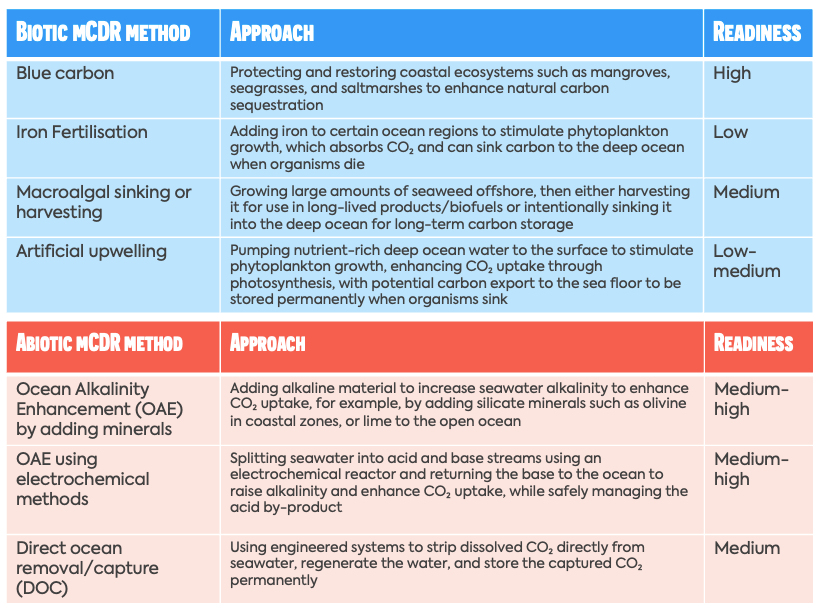
Summary inspired by Oschlies et al. (2025), with technology readiness levels (TRL) drawn from
1 RMI (2023) and the 2 UArtic library of climate interventions and Yao et al. (2025).
Answering these questions will be key to unlocking mCDR’s potential to reduce pressure on terrestrial resources and help create additional removal capacity. Europe’s current carbon removal capacity is limited by the availability of land and by competing needs for agriculture, food security, renewable energy, and biodiversity. On top of that, the future of Europe’s land sink is looking uncertain (e.g., Phili et al., 2022 and Korosuo et al., 2023) as its ability to remove carbon has reportedly decreased over the last decade in the EU due to a declining forest area, aging forests, and increasing harvest rate – trends that will likely only increase with climate change. Forests aside, geological storage capacity is geographically uneven across Europe, reducing our ability to use certain CDR methods. Recognising these constraints early on is key to designing a resilient European carbon removal portfolio that can deliver over the long term.
Europe has strong foundations to advance mCDR
Europe is well placed to explore its mCDR potential as the home to a number of leading marine institutions (GEOMAR (DE), German Marine Research Alliance, with the notable research mission CDRmare, NOC (UK), and IFREMER (FR), among others), with research backed by major funding and innovation programmes like Horizon Europe and the Innovation Fund. It is also home to an emerging ecosystem of industrial players and startups (like SeaO₂, PRONOE, Limenet and SeaFields).
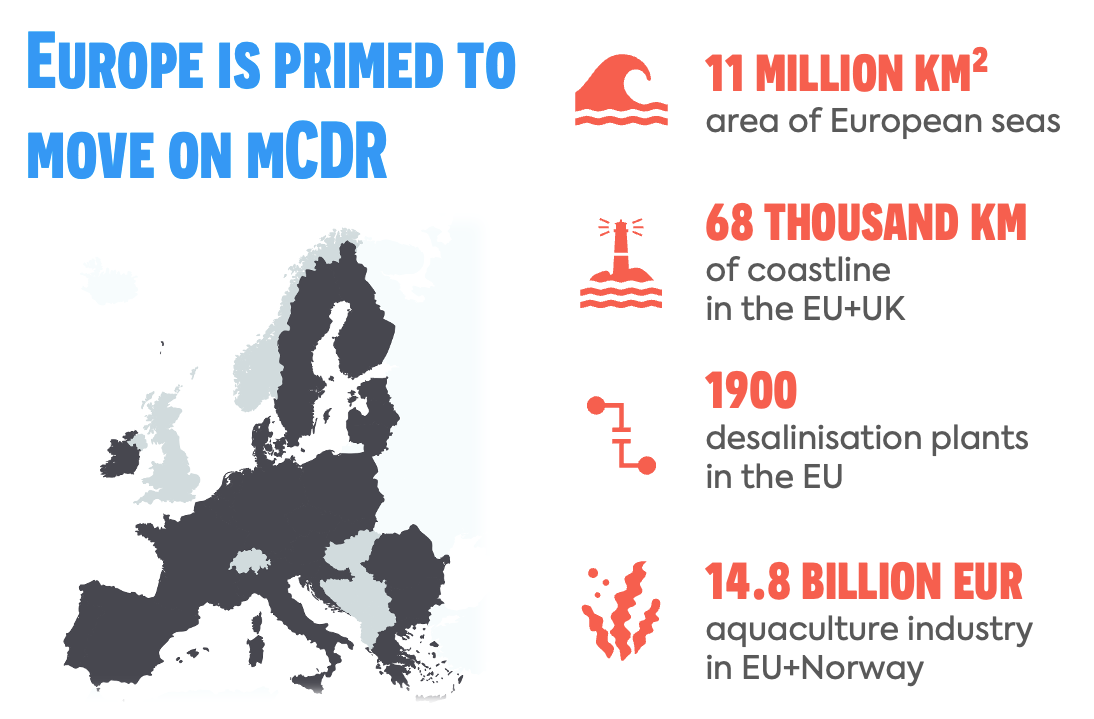
On top of this, Europe’s unique geography makes it especially well-placed to advance mCDR, with more than 11 million km2 of seas and around 68 thousand km of coastline. If we add Europe’s overseas territories, this enormous area provides access to a wide variety of sites to test and eventually deploy mCDR at scale—an important advantage, since the effectiveness of different mCDR approaches strongly depends on local ocean characteristics such as temperature, salinity, and current dynamics. For example, Ocean Alkalinity Enhancement (OAE) is emerging as a promising mCDR technique which is best suited for settings with strong circulation to distribute alkaline minerals and low temperatures that better facilitate the absorption of CO2 into the seawater. For this reason, the North Sea, or North Atlantic more generally are becoming a focus area for OAE research, with some conceptual projects showing the potential for Mt-scale CO2 removals.
Europe also benefits from overseas territories with warm tropical waters, well placed to scale blue carbon projects, since ecosystems like tropical mangroves, seagrass meadows, and tidal marshes are more productive carbon sinks than those in temperate water. Projects in such regions would not currently be included in Europe’s reporting, but through international carbon markets allowed by Article 6 of the Paris Agreement, they could potentially be credited back to Europe. Blue carbon ecosystems admittedly remove a relatively small proportion of CO2 emission, but expanding partnerships and projects in these regions through targeted, large-scale restoration in eroded ecosystems could not only boost removal potential but also promote biodiversity and coastal resilience.
Along with its existing scientific and natural resources, Europe’s current infrastructure could be vital to getting these technologies to scale. Repurposing existing large-scale assets such as decommissioned oil and gas platforms or idle cargo vessels for transport and storage of CO2 could be key. Additionally, the roughly 1900 desalination facilities across the region already handle large volumes of seawater and in some cases their pumping and brine treatment systems could potentially be equipped for adding alkalinity to seawater or removing CO2 electrochemically. Using these existing facilities offers the EU one more asset for improving resource efficiency while addressing issues of highly saline wastewater.
The EU and Norway already have an established aquaculture sector, currently valued at 14.8 € billion, which could be further developed to provide much of the infrastructure needed for key biotic mCDR strategies — from leases and platforms to coastal facilities. By boosting biomass in the ocean and sending some of it to the deep sea, the sector could help lock away carbon while also creating new economic opportunities. In particular, farming cold-water seaweed in the North Atlantic is gaining attention as acarbon removal option approach for Europe.
It’s clear that Europe has the expertise, unique geography, and the infrastructure to have a running start on scaling up mCDR. Yet time is short—if Europe wants to lead, it can’t afford to wait to take action.
To dive into the policy hurdles and opportunities that will shape how — and how fast — Europe can turn this potential into reality, see the next blog in the series.
By Allix Baxter