Marine Carbon Removal: Is the EU Ready to Dive In?
Explore how marine carbon removal can support EU climate goals. Learn about mCDR technologies, Europe’s potential, and why investment, and research are key to scaling ocean-based solutions.
The ocean is the world’s largest carbon sink, yet EU policy barely dips under the surface of the ocean’s massive potential. Marine carbon dioxide removal (mCDR) covers a wide range of methods that harness the oceans power to capture and store carbon. The EU is well placed to develop these methods, but the current fragmented policy framework poses an obstacle to scaling up the industry, one the EU must address if it is to ride the growing wave of interest for these technologies.
Achieving climate neutrality by 2050 requires not only drastic emissions reductions but also a portfolio of carbon removal methods. The EU has already committed support to other CDR methods such as Direct Air Capture (DACCS) and Bioenergy with Carbon Capture and Storage (BECCS), but mCDR methods remain early-stage, underfunded, and surrounded by regulatory uncertainty. Yet if the EU is to tap into mCDR’s potential it must be done responsibly, and part of that responsibility lies in understanding what EU laws touch on mCDR, where the gaps lie, and what the EU should do to position itself as a leader in this emerging field.
The fragmented EU policy seascape
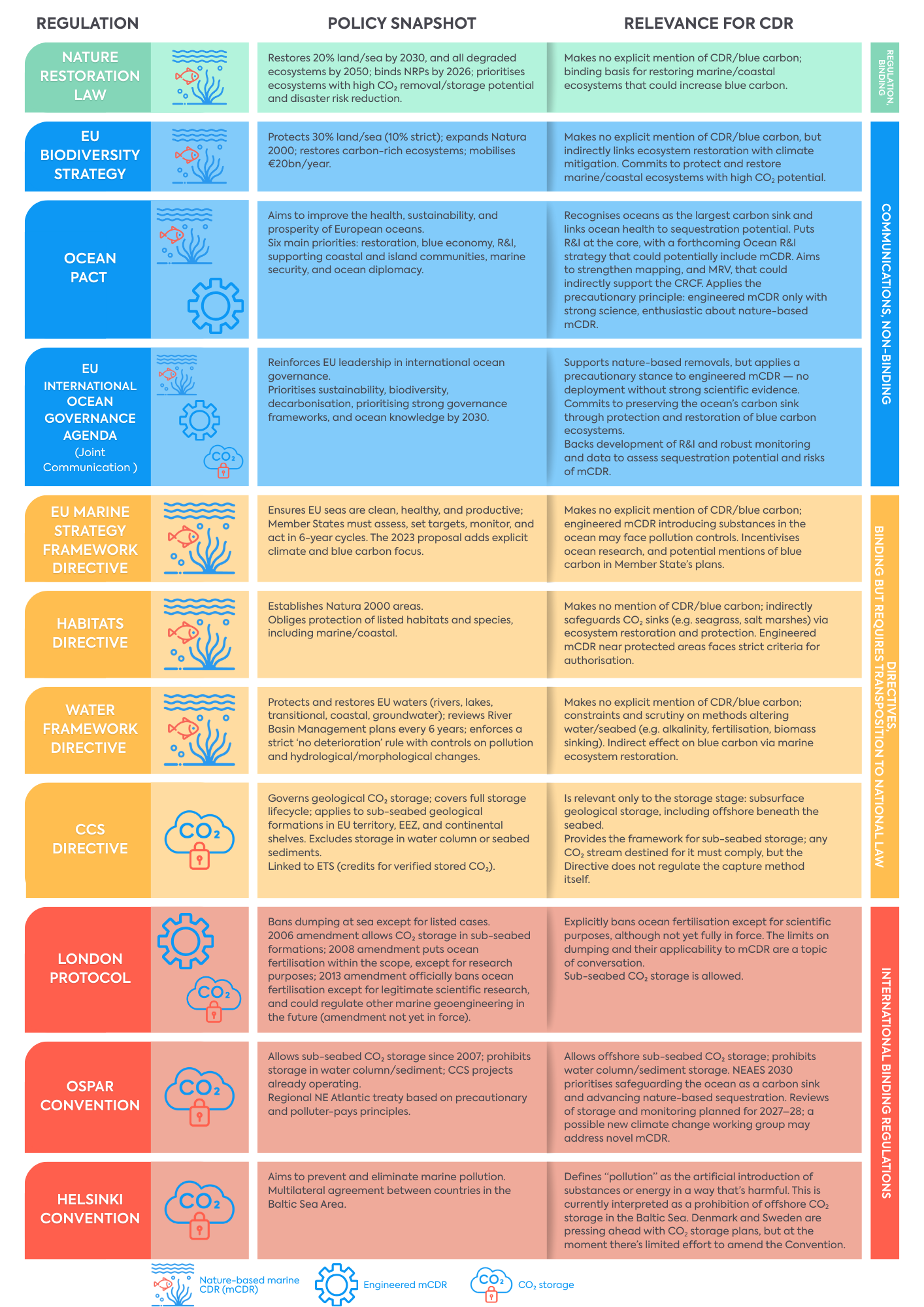
Marine carbon dioxide removal sits at the intersection of biodiversity, marine protection, water quality, climate, and innovation. No single EU law is designed with mCDR in mind, although several frameworks shape what is possible in European seas. Nature-based marine solutions are relatively well protected; the Marine Strategy Framework Directive, the Habitats Directive, and the Water Framework Directive all protect coastal habitats, and indirectly safeguard natural carbon sinks. The new Nature Restoration Law requires restoring 20% of EU land and seas by 2030. It prioritises carbon-rich ecosystems, including enhancing blue carbon storage, and a revision to the LULUCF will include the reporting of wetlands starting in 2026 with a possible extension to marine and freshwater in the future.
However, for engineered approaches, the picture is more complex. International treaties like the London Protocol prohibit dumping substances into the sea unless explicitly allowed. The Protocol is the main legal instrument legislating CO2 transport for storage under the seabed. It bans ocean fertilisation except for tightly controlled research and could in future govern other geoengineering methods. A meeting in mid-October of the International Maritime Organisation (IMO) will discuss marine geoengineering and marine CDR.
Another international treaty, the OSPAR Convention, is limited to the North-East Atlantic Sea; it permits CO₂ storage under the seabed but prohibits it in water columns or sediments. The Helsinki Convention goes a step further, banning offshore CO₂ storage in the Baltic Sea.
The EU has yet to fully endorse CDR. The Joint Communication on International Ocean Governance warrants caution on marine geoengineering but supports further research, a position echoed by the recent EU Ocean Pact (2025), which explicitly recognised the ocean as the world’s largest carbon sink and announced future initiatives, including a dedicated Ocean R&I Strategy to address open questions. However, as of yet, the CCS Directive is the only EU detailed framework for sub-seabed geological CO₂ storage, although it does not govern marine CDR.
IN A SNAPSHOT: EU MARINE CARBON DIOXIDE REMOVAL POLICY

The tide may be turning for mCDR
Fortunately, the winds of change are coming—if the EU seizes the moment. Three major policy developments have the potential to shape the future of marine carbon removal in Europe, but only if policymakers act strategically.
The Ocean Pact: the first sign of a roadmap
Adopted in 2025, the Ocean Pact is the clearest acknowledgement yet of the ocean’s central role in Europe’s climate strategy as a carbon sink. The Pact promises an Ocean R&I Strategy to coordinate investments, a European network of ocean testing sites, and improved marine monitoring systems. These initiatives could be powerful enablers, with the potential to boost research, foster new technologies, and improve the MRV needed to make mCDR credible, but unless mCDR is explicitly included, and strategically prioritised, marine removals risk falling through the cracks.
The new Horizon Europe: a vital opportunity to fund mCDR
The European Commission’s July proposals for the next Multiannual Financial Framework (MFF) and Framework Programme for R&I (FP10) represent a once-in-seven-year chance to scale investment in carbon removal. For marine CDR, this timeline creates the chance to make it an explicit research priority, develop innovation roadmaps, and allocate dedicated funding. Carbon Gap’s research shows at least €2.6 billion is needed over seven years for early-stage CDR research across all methods—marine approaches deserve their fair share.
CRCF: Certification in the making
The Carbon Removals and Carbon Farming Regulation (CRCF), adopted in 2024, is Europe’s framework for certifying carbon removals. Methodologies for DACCS, BECCS, biochar, and land-based approaches are already underway. Ocean alkalinity enhancement and enhanced rock weathering will be part of the next wave starting this September.
Certification is critical, without it, mCDR cannot be integrated into the rest of the EU’s policy framework or markets. But certification also depends on robust MRV systems, sound scientific data and understanding of the methods. That is why the CRCF and FP10 must work in a feedback loop; EU funding should target the scientific uncertainties that the certification needs answering, while the CRCF should help flag research priorities back to the FP10.
Charting the course forward
Even with promising initiatives like the Ocean Pact, FP10, and the CRCF, Europe’s approach to marine carbon removal still has major blind spots, but these have clear solutions:
- No dedicated framework
The problem: Marine carbon removal is scattered across biodiversity, marine, and climate laws, but lacks a coordinated strategy.
The fix: Develop a dedicated EU mCDR strategy that explicitly addresses both nature-based and engineered approaches, aligning biodiversity, marine, and climate objectives. - Permitting: nature vs. engineering tension
The problem: Ecosystem restoration laws encourage blue carbon, but marine protection and anti-dumping rules can block pilots for engineered mCDR. Furthermore, no EU guidance exists for permitting field trials. Innovators face uncertainty even if certification pathways are created.
The fix: issue EU-level permitting guidelines to help Member States authorise safe, consistent pilot and demonstration projects, while maintaining strong biodiversity safeguards. - Unclear rules for engineered methods
The problem: No EU regulation comprehensively covers engineered approaches, international law only partly fills the gap.
The fix: Provide EU-level legal clarity on how these methods can be researched and, if proven safe and effective, responsibly deployed. - Certification and MRV not ready
The problem: Without robust monitoring, reporting, and verification (MRV), mCDR cannot be integrated into EU targets or markets.
The fix: Ensure the development of CRCF methodologies for mCDR methods. - Research and innovation gap
The problem: Multiple scientific unanswered questions remain that need to be addressed as soon as possible, and current funding is insufficient.
The fix: Launch a marine CDR research and innovation roadmap within FP10 and the Ocean Pact R&I Strategy, with milestones directly linked to certification needs.
The coming years will decide whether the EU becomes a leader or a laggard in marine carbon removal. To meet its 2050 climate goals, Europe must match the ocean’s importance with a policy framework equal to the task. The opportunity is here — but it will not wait.
The ocean has been waiting. It’s time for the EU to dive in.